
November 11, 2026
November 11, 2026
Why two quotes for the same event can differ so much, what you are really paying for, and how to compare them without nasty surprises.
«How much does an interpreter cost for a morning?» It is the question I am asked most often and also the hardest to answer in one line, because the honest reply starts with another question: it depends which morning.
That is not a dodge. Two events of the same length can cost very differently, and understanding why is what lets you compare quotes properly instead of looking only at the final figure. After nearly thirty years preparing quotes and seeing other people's, here is what you are actually paying for.
This surprises almost everyone. Interpreting is not billed per hour worked but per day or half day. That is the standard across Spain and most of Europe.
A half day covers roughly up to three or four hours; a full day covers the whole day. A ninety-minute meeting and a three-hour meeting usually fall in the same band and therefore cost the same.
It seems unfair until you look at what sits behind it. If I work from ten to half past eleven, I cannot take another booking that day: for a four o'clock meeting I would need certainty that the first one will not overrun, that the travel fits and that nothing changes at the last minute. What you are booking is not the ninety minutes, it is the availability of the day.
And that is before counting what you do not see, which is half the work.
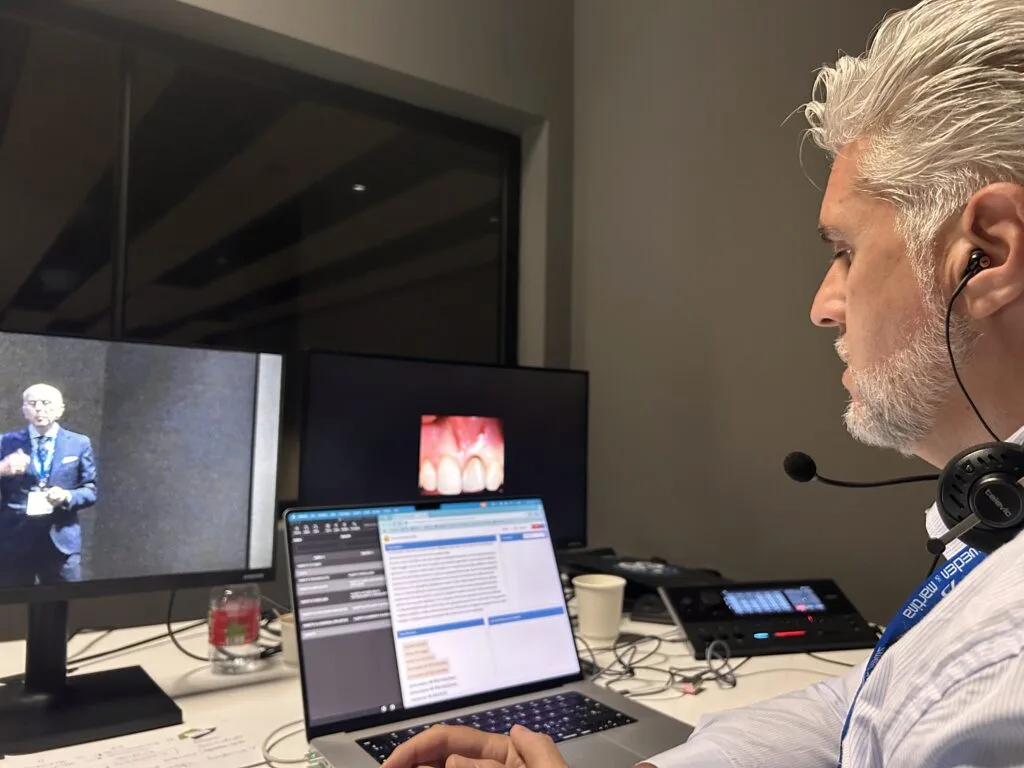
A dental implantology congress is not interpreted by turning up on the morning. It means reading the programme, studying the slides, revising the terminology of the field, looking up who the speakers are and what they have published, and building a glossary of the terms that will come up.
For a technical assignment that preparation can take several hours or a couple of days. It is not billed separately, but it is inside the day rate. It is in fact what separates an interpreter who arrives knowing the subject from one who improvises, and you can hear it from the first sentence.
From which follows something practical: the more specialised the subject, the more preparation it takes and the more it costs. A commercial meeting between two companies that already know each other is simpler than a paper on the bioequivalence of generic drugs.
This is the biggest single difference between quotes, and the first thing worth checking.
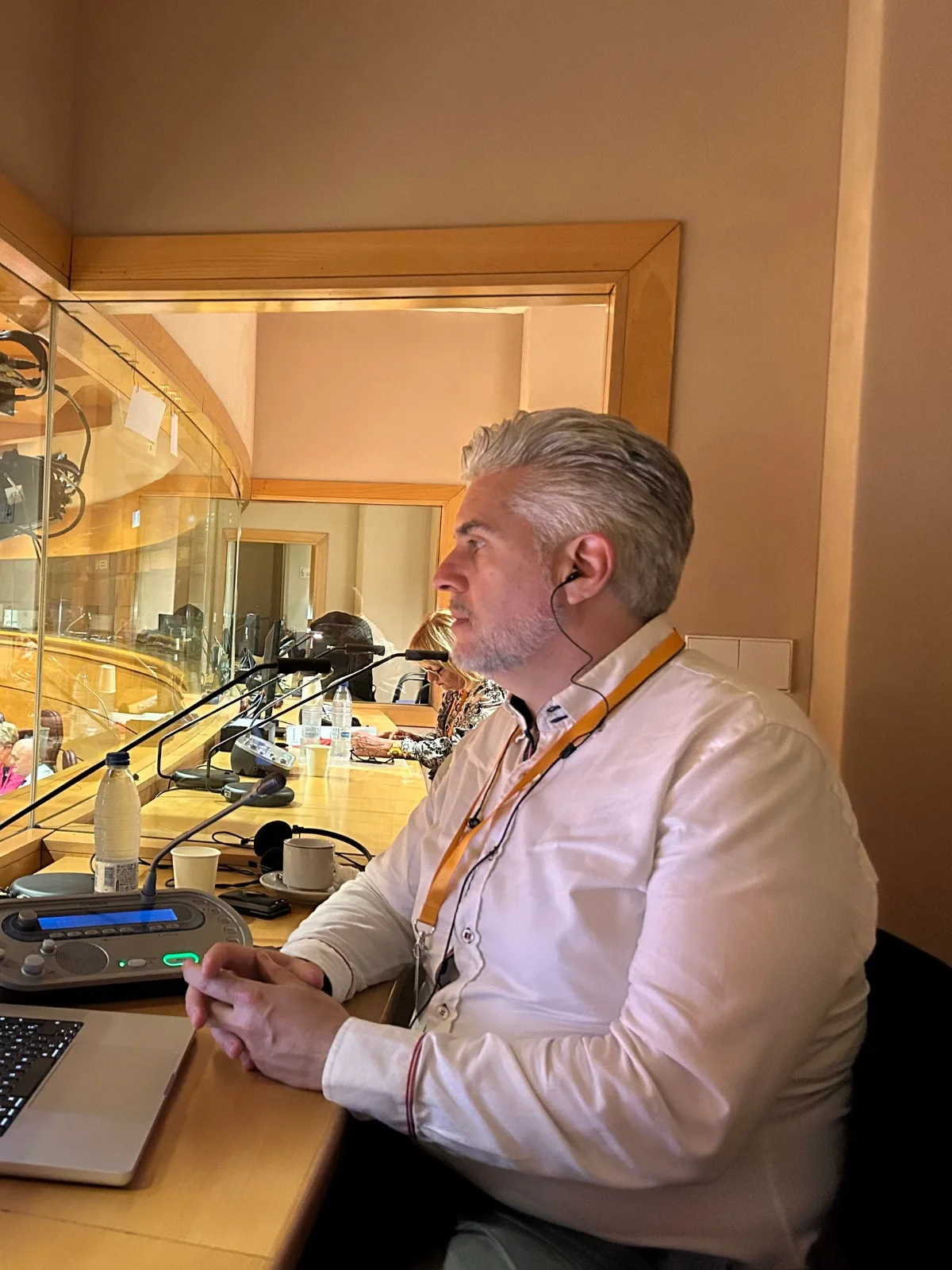
Simultaneous interpreting demands a level of concentration nobody sustains indefinitely. Established professional practice is two interpreters per booth, swapping every twenty or thirty minutes. This is not a trade-body demand: past a certain point quality falls, and it falls before the interpreter notices.
So if one quote offers a single interpreter for six hours of simultaneous work and another offers two, you are not comparing like with like. The first is cheaper on the invoice and more expensive in the result.
There are reasonable exceptions: short events, an hour or less, on a single topic and without debate, can be covered by one person. A good interpreter will tell you so without being asked.
In consecutive and liaison work one person is normally enough, because there are natural pauses and the effort is different.
My combination is Italian, Spanish and English, both ways. If your event also needs German or Chinese, a team has to be assembled and the quote grows accordingly: more booths, more pairs of interpreters, more coordination.
One nuance worth knowing: when languages that rarely meet are combined, interpreters sometimes work through relay. The Japanese booth interprets into English and the other booths work from the English. It works and it is standard at international organisations, but it adds a slight delay and needs coordination. If your event needs it, have it explained beforehand rather than on the day.
If the event is simultaneous and on site, you need a soundproof booth, a console, receivers with earpieces for the audience, microphones for the speakers and a sound engineer throughout.
The interpreter does not charge for that: the equipment company does. And it is often a substantial part of the total, sometimes larger than the interpreters' fees, especially when there are many receivers.
That is where it pays to be precise. The number of receivers is calculated from the attendees who will listen to the interpretation, not from everyone in the room. At a 200-person conference where only forty need translation, hiring 200 receivers is money thrown away. It is worth estimating with the registrations in hand.
I can coordinate that side so you do not have to deal with two suppliers, but you should know they are two separate items and that a quote should list them separately.
If the event is in Madrid and I live in Madrid, there is nothing to add. If it is in Bilbao, Palermo or Frankfurt, the quote includes travel, accommodation where an overnight stay is needed and, when the journey eats a whole day, compensation for that day.
It is the easiest item to anticipate and the one that causes most friction when it is not discussed at the start. Ask about it in your first email.
One detail that saves money: if an event starts at nine in the morning far from where the interpreter lives, they have to travel the previous afternoon and stay over. If it starts at eleven, it can often be done in a day. Moving the start by two hours can remove a hotel night from the invoice.
Remote interpreting saves the travel, the hotel and the physical booths, so it costs less. But there is still a day or half-day rate, still preparation, and in long sessions still two interpreters.
There is also a new cost: the platform. Zoom and Teams include interpretation channels in some plans. Interprefy, Kudo, Olyusei and Interactio are separate services, with their own fee and usually a technical moderator. If your event matters, that role earns its keep.
And a warning I always repeat: remotely, the quality of the audio reaching the interpreter determines the quality of what comes out. Saving on headsets and skipping the technical test is the cheapest way to spoil an expensive event.
Serious quotes include cancellation terms, and they are worth reading. The logic is the same as the day rate: a booked date is a date on which other work was turned down.
Typically a cancellation well in advance carries no cost and, past a certain point — a few days before — part or all of the fee is charged. If your event has a real chance of moving, say so from the start: something reasonable can almost always be agreed in advance.
If you have two offers and cannot see why one is dearer, check these before the total:
An offer well below the others is almost always explained by one of the first four lines.
After all these years, what I have seen inflate quotes is not the day rate. It is something else: last-minute changes.
A language added two days before, a room swapped for one with no booth, an event that grows from three hours to six, an on-site format that turns hybrid the week before. All of it can be handled, but handling it in a hurry costs more than planning it with time.
The most effective way to keep a quote under control is to give complete information in the first email and flag changes as soon as you know them.
Because they would mislead. A half day of liaison work in Madrid and a day of simultaneous interpreting at a medical congress in Milan with two interpreters have nothing in common, and a «from» figure would leave half the people who ask surprised. I prefer to ask four things and give a firm number.
Four details: date, place, languages and approximate duration. With those I reply the same day. If you also tell me what the event is about and how many people will listen to the interpretation, the quote comes back precise and without small print.
In the moment, yes. Speaking two languages and knowing how to interpret are different things: interpreting is a technique you study, and an untrained bilingual person is spent after twenty minutes, summarises without meaning to and loses the nuances exactly when they matter. For an informal lunch it can work. For a negotiation, a hearing or a technical paper, the saving is expensive.
There is, but not because of the mode itself, rather because of what it brings with it. Simultaneous tends to cost more because it involves equipment and often two interpreters. Consecutive needs no equipment but doubles the length of the event, and that has a cost too.
Yes. I work across Spain and have interpreted in more than ten countries. Outside Madrid, travel and, where applicable, accommodation are added.
What you pay for when you hire an interpreter is not hours of presence: it is the preparation, the availability of a full day, the technique of someone trained for it and, when needed, a second professional who makes sure the quality holds to the end.
If you are planning an event and want a firm figure, write to me with the date, place, languages and duration from the contact page, or ask directly for a quote. I reply the same day, and if I think you need something simpler than you had in mind, I will say so.
And if you are still deciding which mode fits, start here: simultaneous, consecutive or liaison.
November 11, 2026
November 11, 2026
November 11, 2026