
November 11, 2026
November 11, 2026
The mode you choose changes the quote, the length of the event and even the room you need. Here is when I use each one, and the mistakes I have seen repeated since 1997.
I get the same call almost every week. Someone is organising a conference, a press event or a meeting with a Spanish company, and they open with: «I need a simultaneous translator». Sometimes that is exactly right. Quite often it is not, and what they actually need is something simpler and cheaper.
The confusion makes sense. From the outside every mode looks the same: someone listens in one language and speaks in another. But the differences between them affect the quote, how long the event runs, the equipment you have to hire and even how the room is set up. Choosing badly rarely ruins an event, but it leaves it limping: programmes that overrun by half, speakers who lose their thread, audiences that drift off after twenty minutes.
I have worked between Italian, Spanish and English since 1997, and I have watched these decisions go well and badly at medical congresses, in courtrooms, at film festival press conferences and on factory visits. What follows is, more or less, what I tell people on the phone when they call with this question.
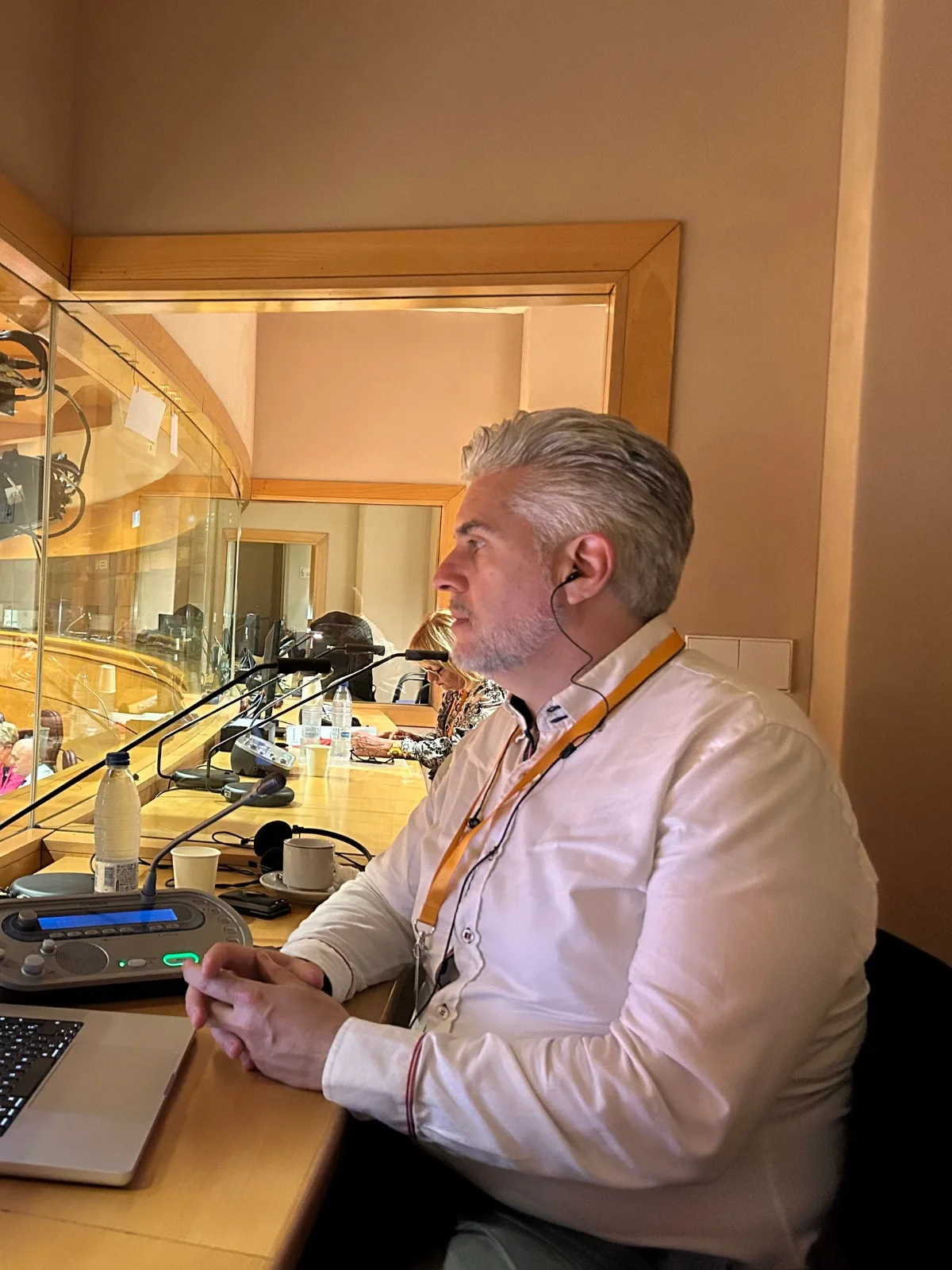
In simultaneous mode I speak while the speaker speaks. I run a few seconds behind — just enough to see where the sentence is going — and the audience hears me through a receiver and an earpiece. The event lasts exactly as long as it would without an interpreter.
That is its great advantage and the reason it is the mode used at conferences. If you have a full day with twelve presentations and a fixed programme, there is no alternative: anything else would force you to cut half the content.
Three things usually surprise first-time clients.
It is not one interpreter, it is two. Simultaneous interpreting demands a level of concentration nobody sustains indefinitely. Standard practice is to work in pairs per booth and per language combination, swapping every twenty or thirty minutes. This is not a luxury or a way of padding the invoice: past a certain point quality drops, and it drops in a way the interpreter does not always notice. Short events, an hour or less on a single topic, can be covered by one person.
You need equipment. A soundproof booth, a console, receivers with earpieces for the audience, microphones for the speakers and a sound engineer for the whole event. International standards describe what that equipment should be: ISO 2603 for fixed booths and ISO 4043 for mobile ones, the kind set up in hotels and conference centres. This is not red tape: a poorly insulated booth forces you to turn the earpiece up, and two hours later the interpreter is exhausted and the audience can tell.
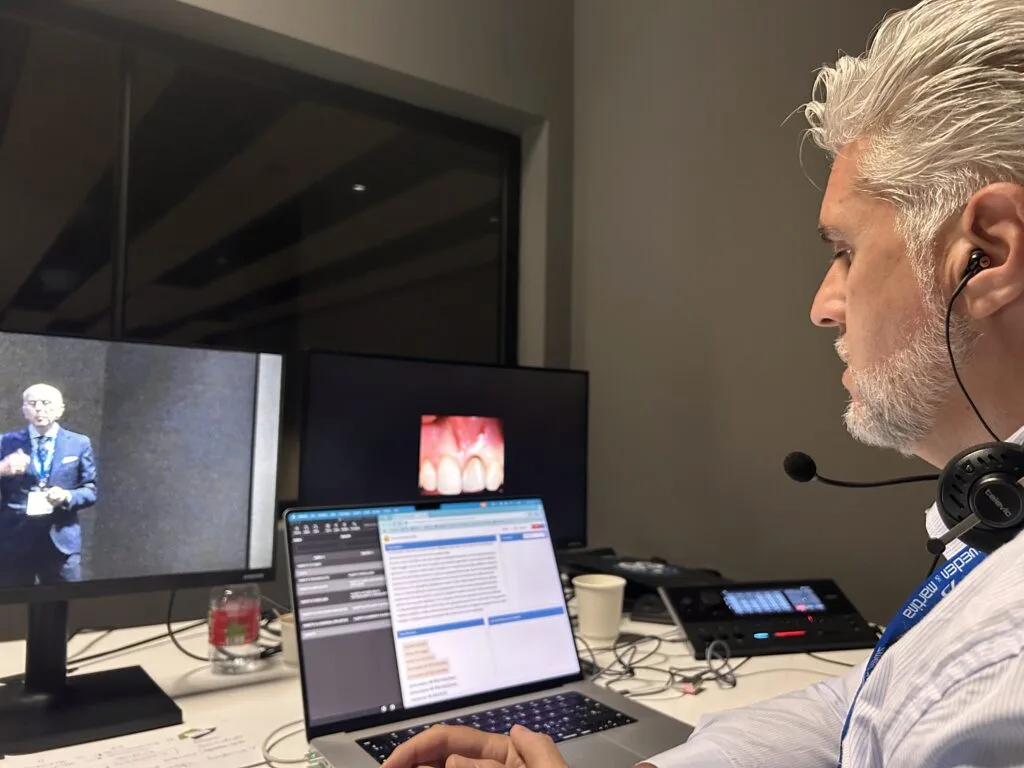
The booth has to see the room. This is forgotten constantly. When the booth is set up in a back room or behind a pillar, we lose the slides, the speaker's gestures and the finger pointing at «this graph here». Interpreting blind is like translating a phone call with interference: possible, but things get lost. If the booth cannot have a line of sight, ask for a monitor with the room feed and another with the slides.
I use simultaneous interpreting at international conferences, shareholder meetings, technical presentations, seminars and any event with a tight programme and a sizeable audience. If that sounds like yours, the details are on the simultaneous interpreting page.
In consecutive mode the speaker talks for a stretch — anything from one minute to five or six — and then stops. Then I speak and render what they said. I take notes while listening: not shorthand, but a system of symbols and links I learned at university and that every interpreter ends up adapting.
Consecutive needs no booth, no receivers and often no equipment at all. Two microphones and little else. That makes it ideal for smaller occasions: press conferences, signing ceremonies, after-dinner speeches, interviews, book launches.
But it comes with a cost you have to build in from the start: the event takes roughly twice as long. If the managing director has twenty minutes of speech, allow forty. This is the most frequent mistake I see: the programme is locked without accounting for interpreting, and halfway through someone gestures at me to «go faster», which is like asking a translator to use fewer letters.
Consecutive also has a virtue simultaneous does not. Because there is a pause between what is said and what is rendered, I can order the idea, rescue a sentence the speaker abandoned halfway and pick the exact term. At a film festival press conference, where a director answers a long question with a reply that branches three ways, that pause is worth a great deal. In the events with Italian writers and film-makers I have interpreted over the years, we have almost always worked this way.
There is more on the consecutive interpreting page.
There is a third case that fits neither of the above: people are on the move. A factory visit, a walk around a trade fair, a site inspection, a business lunch, a meeting of six people around a table.
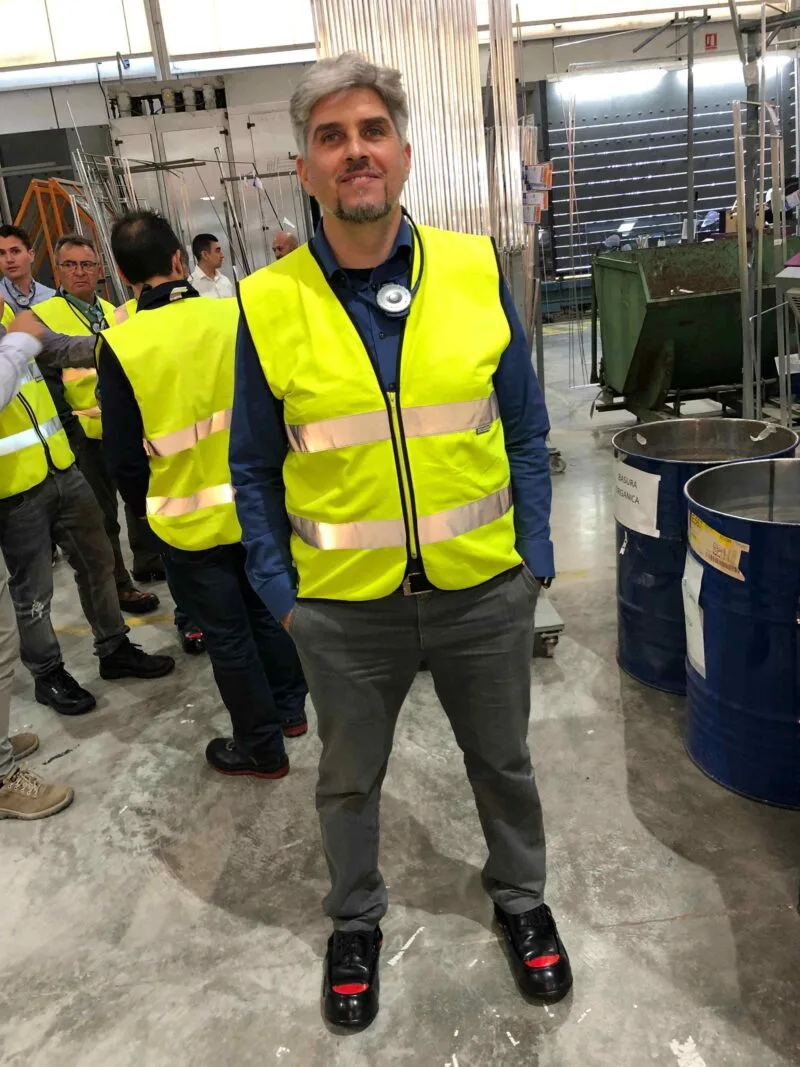
There I work in liaison mode: I go with the group and interpret both ways in short turns. If the group is large or the place is noisy — and an industrial plant always is — we use a portable transmitter and earpiece system, the kind everyone calls an «infoport». They are light cases, handed out in two minutes, and they let twenty people follow the explanation while walking.
It is the most informal mode and the one most often underestimated. In a commercial negotiation the liaison interpreter stands half a metre from both parties, hears the asides and senses when someone says «we will think about it» meaning «no». That closeness calls for a very clear sense of what interpreting is and is not: my job is for both sides to understand each other, not to advise or mediate.
I explain it further on the liaison interpreting page.
In two contexts the mode matters less than how you work, because what is at stake is different.
In legal settings — courts, statements, notaries — everything is interpreted: the repetitions, the half-finished sentences, the tone. You do not summarise, you do not tidy up the speaker's syntax and you do not answer questions the witness puts to you directly. It usually combines consecutive for statements with whispered simultaneous into the defendant's ear for the rest of the hearing. It carries a particular kind of tension, because any nuance lost can have consequences.
In medical settings something similar applies, with an added weight: the interpreter is often the only channel through which a patient understands their diagnosis. In consultations and medical congresses, where I have worked for laboratories and at specialist meetings, the vocabulary is prepared weeks in advance. A dental implantology congress cannot be improvised.
Remote interpreting stopped being unusual years ago and is now simply another option. I work with Zoom, Teams, Interprefy, Kudo, Olyusei and Interactio, which are the platforms clients tend to ask for.
It works, and works well, on one condition I always repeat: the audio reaching the interpreter has to be good. Not «acceptable»: good. When a speaker joins from a laptop using the built-in microphone, in a room with echo and the camera two metres away, what reaches me is compressed sound from which the words have to be reconstructed one by one. You can do that for fifteen minutes. Not for three hours, and the result shows.
The fix costs very little: headsets with a boom microphone for everyone who will speak, a cable connection instead of wifi wherever possible, and a technical test the day before with the actual speakers. That test solves ninety per cent of the problems and almost nobody runs it.
If your event is remote or hybrid, the details are on the remote interpreting page.
If you want a quick rule before asking for a quote:
After this many years, what separates an event that goes well from one that goes so-so is almost never the mode. It is something else: the information the interpreter gets beforehand.
The programme, names and job titles spelled correctly, the slides even if unfinished, the document to be signed, the company's internal acronyms, the video that will be played. I study all of it in advance. A congress with materials sent a week ahead and a congress with materials handed over at the door are not the same job, even if the invoice is identical.
And one small detail makes an enormous difference: tell your speakers there will be interpreting. Not so they speak oddly, but so they know that reading a written text at full speed makes the job harder; and that if they are going to quote a law, a poem or a run of figures, that part should reach the interpreter in advance.
With four details — date, place, languages and duration — I can answer the same day. What I need to know first is whether equipment is already booked or has to be included, because that is where much of the price difference sits.
For one-off dates, a couple of weeks is usually enough. In high season — late spring and autumn are conference months in Madrid — the earlier the better. And if your event needs several languages, the lead time is not for me: it is for assembling the team.
Yes. I work with booth and sound suppliers and can coordinate the technical side so you do not have to deal with two companies. I also put together interpreter teams when an event needs more language combinations than mine.
That is exactly when it is worth calling. Tell me what the event is, how many people are coming and how much time you have. I will tell you which mode fits, what you need and what you do not, even if the answer is that you need something simpler than you thought.
You can write to me from the contact page or ask directly for a quote.
November 11, 2026
November 11, 2026
November 11, 2026