
November 11, 2026
November 11, 2026
They are not the same profession and you do not book them the same way. Here is the difference, when Spain requires a sworn translation, and why a good translator is not automatically a good interpreter.
There is a long-standing confusion that costs people money: calling everyone who works between two languages a «translator». In everyday conversation it does not matter. When you are hiring, it does, because these are two different trades with different techniques, and plenty of people end up asking for the thing they did not need.
The rule is simple and you learn it in your first year at university: translation is written, interpreting is spoken. A translator works with texts; an interpreter works with people talking. I have done both since 1997, and I can tell you they resemble each other far less than they appear to from outside.
A translator receives a document and delivers another document. There is time: you can check sources, compare how something is phrased in equivalent texts, let it rest and revise it the next day. The result is measured in accuracy and in whether the final text reads as though it had been written in that language rather than translated into it.
What usually comes my way here: contracts, technical manuals, websites, reports, commercial correspondence, training material, product documentation.
It is almost always charged per word or per page of the original, and the deadline depends on volume and subject. A twenty-page contract is not twenty pages of catalogue.
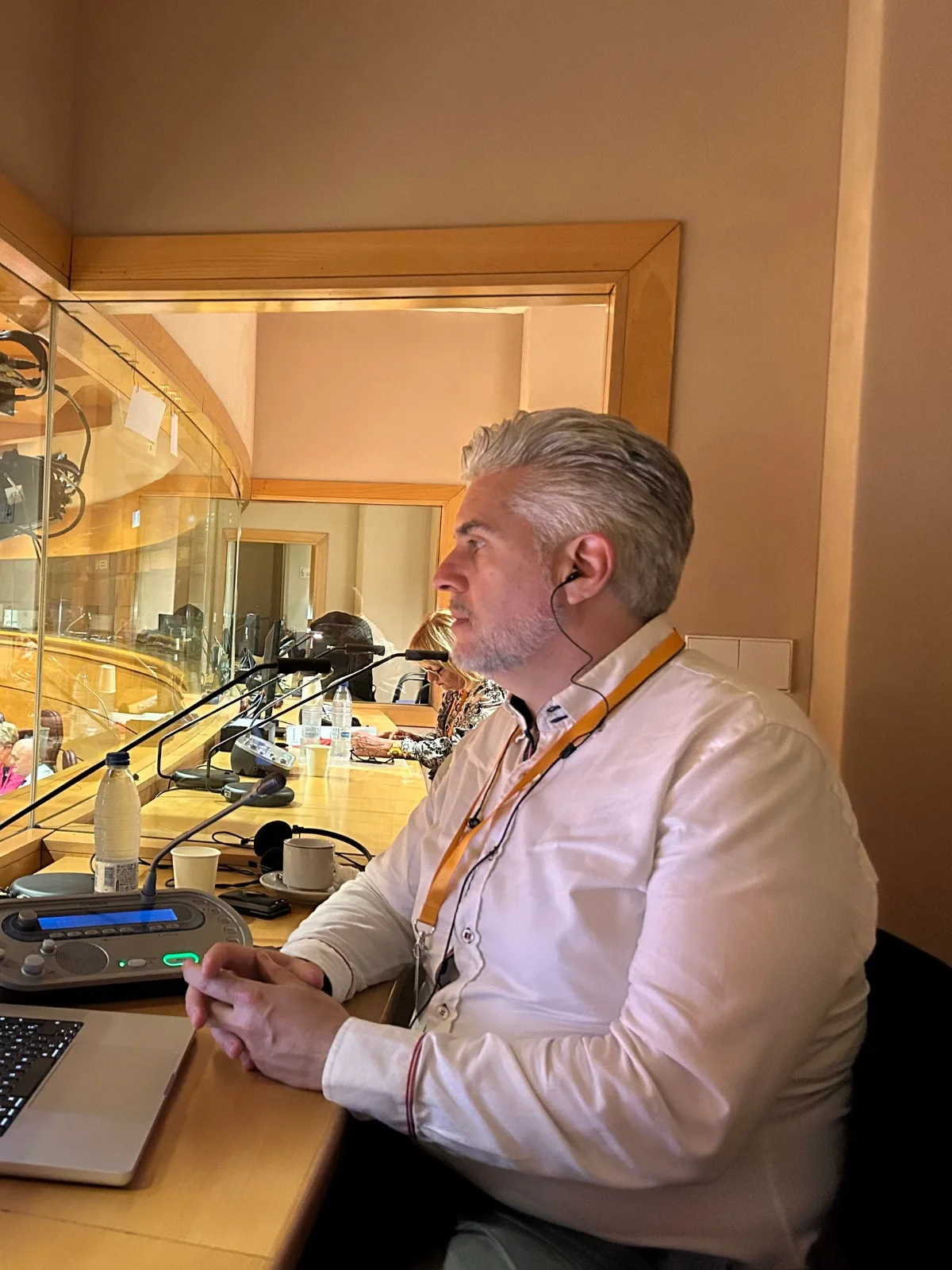
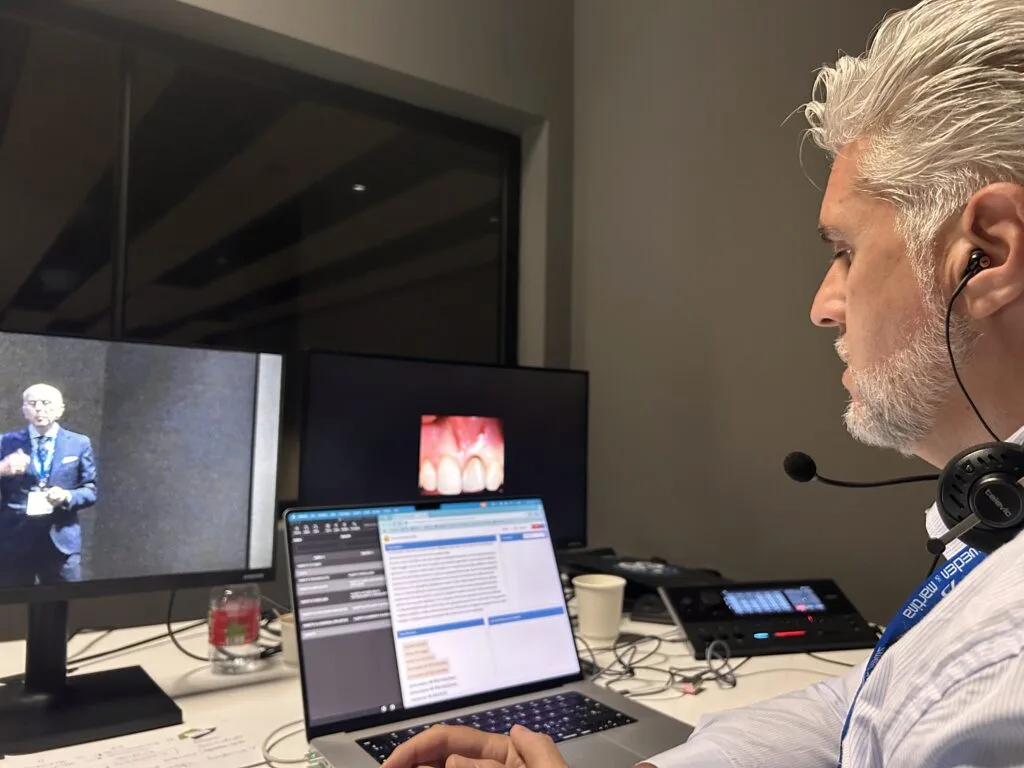
An interpreter works live. There is no second attempt, no dictionary open and no time to find the perfect phrasing: you decide in seconds and move on.
That takes a trained technique: in simultaneous mode, listening and speaking at once, which the brain does not do naturally; in consecutive mode, a note-taking system that is not shorthand but a map of ideas and links that lets you rebuild five minutes of speech.
It is charged by day or half day, not by the hour, and much of the work happens beforehand: studying the subject, preparing terminology, finding out who is speaking and about what.
This is the part that is hardest to explain, and I say it with no condescension towards either trade, since I practise both.
An excellent translator may have a command of vocabulary beyond that of any interpreter and still freeze in a booth, because the skill required is a different one: tolerating imperfection in exchange for immediacy. In simultaneous mode, the good sentence that arrives late is worth nothing; the correct sentence that arrives on time is worth everything.
And the other way round: an interpreter used to solving things on the fly can write in a hurry and leave a text that, read calmly, sounds translated.
So when someone asks me for «a translator for a meeting», the first thing I clarify is whether they want someone to translate a document or someone to be in the room. It is not the same person, even when it is.
Here is another widespread confusion, and this one has practical consequences for anyone dealing with Spanish paperwork.
In Spain a traducción jurada (sworn translation) is not a better or more careful translation. It is a translation with official standing before the authorities, signed and stamped by a Traductor-Intérprete Jurado appointed by the Spanish Ministry of Foreign Affairs. That appointment covers one specific language pair and appears on a public list the ministry itself publishes.
The UK system is different, and it is worth knowing so you do not assume they are interchangeable. There is no sworn translator figure in the United Kingdom: what is normally asked for is a «certified translation», signed by the translator or an agency attesting to its accuracy, sometimes with a statement of truth or notarisation on top. That is not the same mechanism.
The practical consequence: if you have to submit a document to a Spanish body, they will almost always want a sworn translation by a translator on that Spanish list. A UK certified translation may not be accepted, and the reverse is equally true. Before commissioning anything, ask the receiving body exactly what they accept.
You need one when the document will have legal effect: academic qualifications for recognition, birth or marriage certificates, criminal record checks, inheritance paperwork, deeds, powers of attorney, documents for court proceedings.
You do not need one for a private contract between two companies that simply want to understand each other, nor for a manual, nor for a website.
Two warnings. First: if you are asked for a Spanish sworn translation, check that whoever does it is on that ministry list; a non-sworn translator's stamp carries no weight, however good the work. Second: always ask the receiving body what format they accept, because sometimes a Hague apostille is also required on the original document, which is a separate and prior step.
I am an interpreter and translator with university training in both disciplines, but not every translation requires a sworn translator, and when one is required I say so rather than taking the job.
«I have a meeting with a Spanish supplier next week.» Liaison interpreting. One person, no equipment, in the room. If something has to be signed afterwards, you may also need the document translated, which is a separate job.
«We are launching our website in Spain.» Translation, and it is worth discussing localisation: translating is not enough, you have to adapt date formats, addresses, forms of address and sometimes the examples. A literally translated text is spotted immediately and costs you credibility.
«My daughter is studying in Spain and they want her degree translated.» Spanish sworn translation. And before commissioning it, ask the receiving university exactly what they require.
«We are running a conference with Spanish speakers.» Interpreting, almost certainly simultaneous. I cover it in this article on the modes.
«We have a hearing and one of the parties does not speak Spanish.» Legal interpreting, and it is worth telling the interpreter what kind of proceeding it is in advance.
«We want to subtitle a corporate video.» Neither one exactly: that is audiovisual translation, with its own rules on screen time and characters per line. It resembles translation but forces you to condense.
Translation suffers the same fate as interpreting: the time is almost always underestimated, and for the same reason, which is that only the typing gets counted.
A professional translator handles in the order of two to three thousand words a day when the text is of medium difficulty and you want to deliver something revised rather than a draft. A dense contract, a patent or a document from a tightly closed field slows that down considerably. And on top of that figure comes the revision, which is not a luxury: it is where you catch the mis-copied numbers, the double negatives and the sentences that on rereading do not mean what they seemed to.
On urgent texts there is an uncomfortable thing worth saying. They can be done, and they are done, but past a certain point haste is paid for in quality, not only in price. If the document matters and the date is immovable, the time to commission it is now, not when the final version exists: you can almost always start from an advanced draft and adjust the changes afterwards, which is far quicker than translating the whole thing against the clock.
One detail that saves days: send the text in an editable format. A scanned PDF or a deck with the text inside the images means rebuilding the original before any translating can start.
Beyond technique, both trades rest on the same thing, and it is not the language.
It is knowing the field. Translating a clinical trial report requires understanding what the report is about. Interpreting a director presenting their film requires having seen it and knowing their earlier work, because if they cite a film-maker from the sixties you need to know who that is. At the events with Italian writers and film-makers I have interpreted, the preparation was as much about reading their books as revising vocabulary.
And it is knowing what not to touch. A translator does not improve the contract they are translating, even on spotting a badly drafted clause: they translate it and flag it. An interpreter does not soften what one party has just said in a negotiation, however blunt it sounded. In both cases, the urge to help is the beginning of a problem.
Many do, myself included, but it is not a given. They are separate assignments with separate timescales and rates. If you need both for the same project, say so from the start and it can be planned properly.
To get the gist of an email, it is. For a text that will represent your company, be signed before a notary or be published, it is not. Machine translation fails exactly where failure is expensive: nuance, double meanings, the terminology of a specific sector and, above all, when it gets something wrong it does so with complete confidence and no warning. As a support tool with professional revision on top, that is a different conversation.
It is simultaneous interpreting without equipment: the interpreter sits beside one or two people and renders the speech quietly into their ear. It works for meetings where only one side needs translation and for court hearings. It does not work for more than two listeners or in noisy rooms.
No. The sworn translator-interpreter role matters before public authorities and courts. For a business meeting, what you need is a professional interpreter with experience in your sector.
If what you have is a document, you need translation. If what you have is a conversation, you need interpreting. And if that document will have legal effect before a Spanish official body, you need a sworn translation, which is a third thing entirely and is done by someone appointed for it.
Tell me your case from the contact page and I will tell you which of the three it is, even if the answer is that you do not need me. If you already know, ask for a quote directly, and if you want to know what drives the price, I explain it in this other article.
November 11, 2026
November 11, 2026
November 11, 2026