
November 11, 2026
November 11, 2026
Lead times, the room, the sound, the materials and the Q&A. The checklist I wish I had had in front of me at a good few conferences.
An event with interpreting succeeds or fails long before it starts. By the time I sit down in the booth, ninety per cent of what will happen that morning has already been decided: it depends on where the booth was placed, which microphones were hired, whether the slides arrived and whether anyone briefed the speakers.
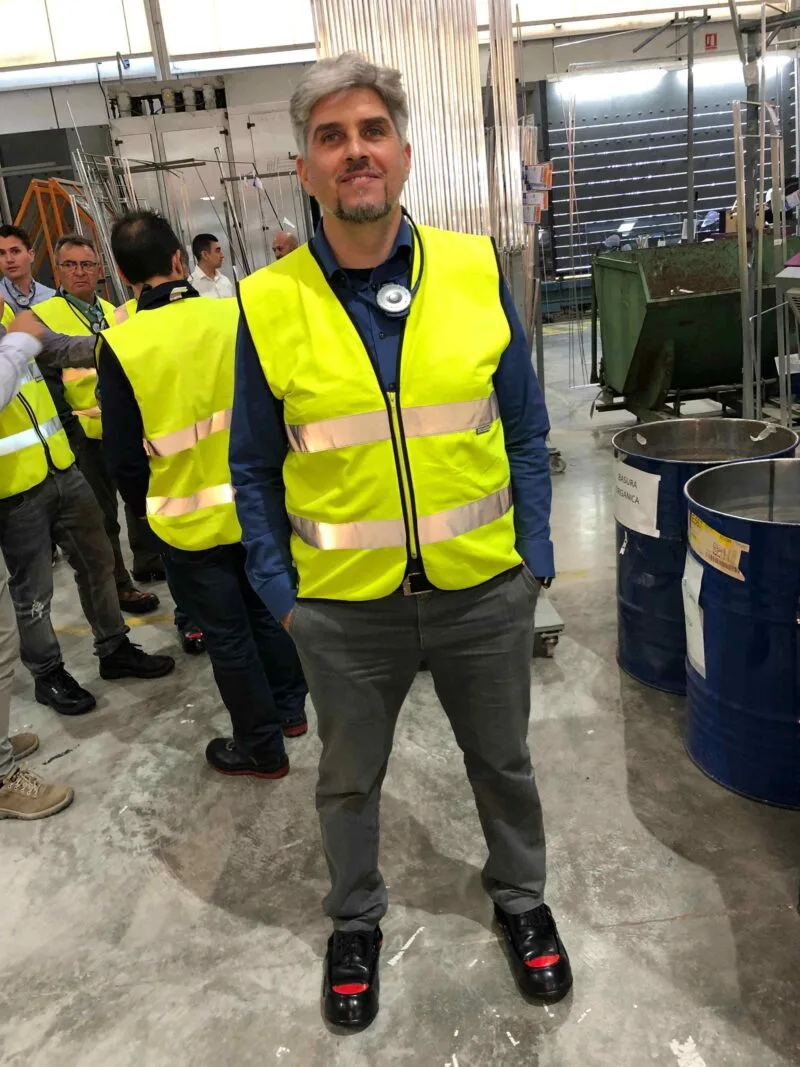
I have been interpreting at conferences, press events, shareholder meetings, courts and factory visits since 1997, in Spain and in ten other countries. In that time I have watched the same mistakes repeat themselves with remarkable consistency, almost always made by capable people organising their first multilingual event, who had no particular reason to know any of this.
Here is what I would check, in order, if I had to organise an event with an interpreter tomorrow.
The first job is not to find an interpreter: it is to be clear about the format. How many speakers, how many attendees, how long it runs, whether the audience moves around and which languages are involved.
That decides the mode, and the mode drives everything else. If it is simultaneous, you need a booth, receivers and a technician, and the budget multiplies. If consecutive will do, you save the equipment but the event takes twice as long. If the group moves, you want portable systems. I go through it in another article: simultaneous, consecutive or liaison.
Two warnings about the calendar. First: in Madrid, late spring and the autumn months are conference season, and good interpreters in specific language pairs run out. Second: if your event needs more languages than one person covers, the lead time is not about the main interpreter, it is about assembling the team. Four languages means several booths and several coordinated pairs.
This is where the most expensive mistakes are made, because by the time they show up there is no room to fix them.
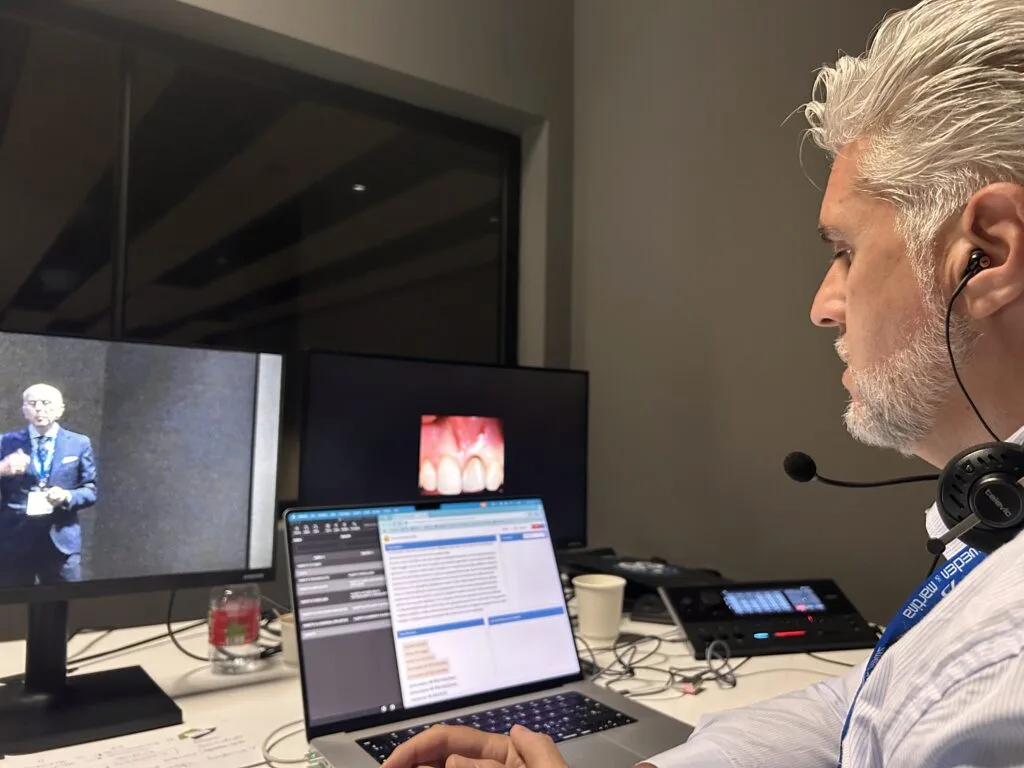
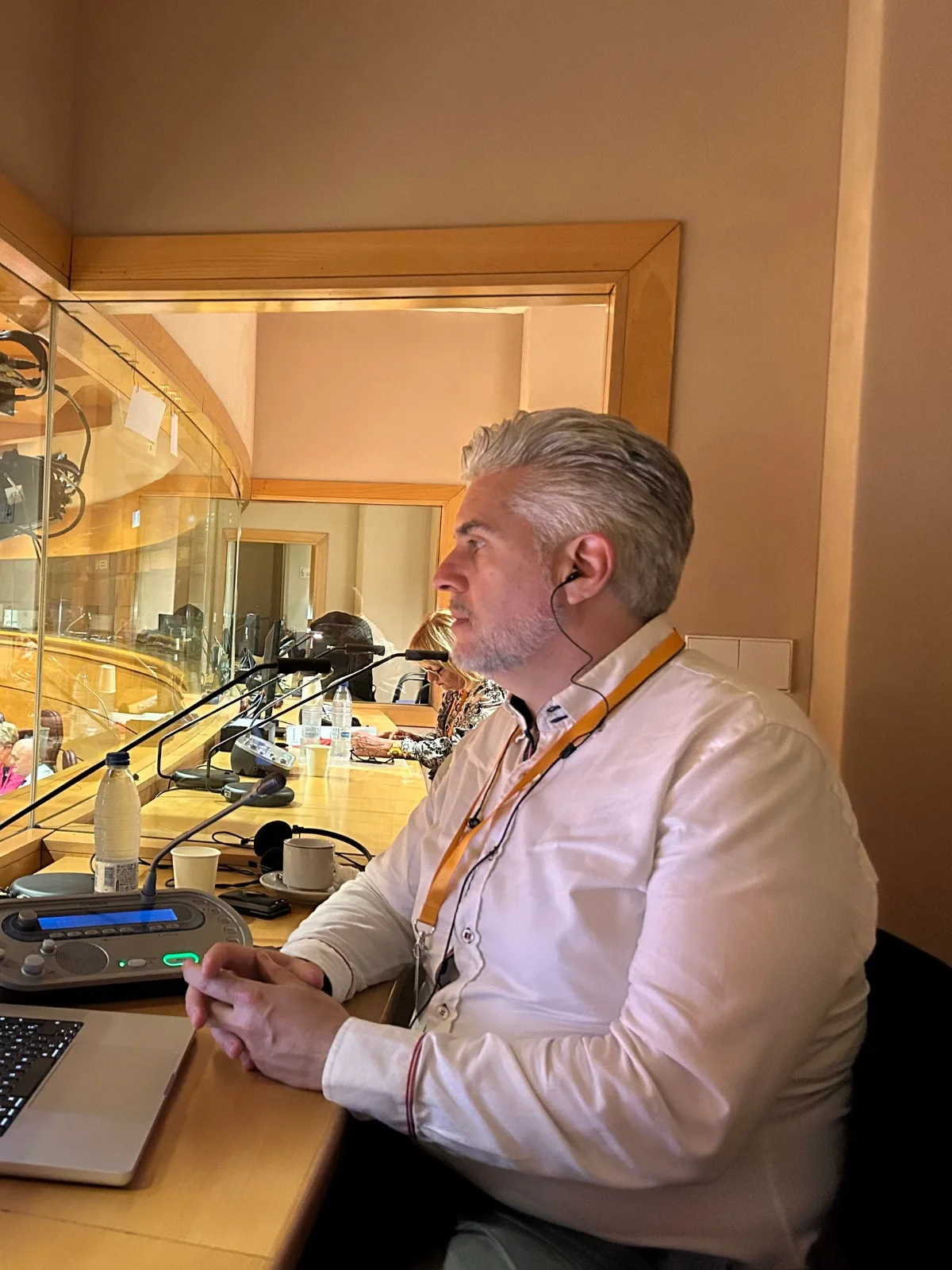
The booth has to see the room. I repeat it in every pre-event email. From the booth I need to see the speaker and the screen. Otherwise I lose the slides, the graphs and the gestures; and when someone says «as you can see here», I cannot see anything. If for whatever reason the booth ends up in an adjoining room — which happens in hotels and historic buildings — ask for a monitor with the room feed and another with the slides. It costs little and changes the result.
A booth is not a table with a screen round it. Decent mobile booths meet ISO 4043, which sets out insulation, ventilation and dimensions. Fixed ones follow ISO 2603. A poorly insulated booth forces you to turn up the earpiece to cover your own voice, which leads to listening fatigue and a drop in quality. If you are offered an «open» booth, know that it is a workaround.
Ventilation. A closed booth with two people inside for four hours becomes an oven if the fan does not work or has been switched off because it was noisy. Check it during the set-up.
Where the audience sits. Receivers have a limited range. If the event is in a long narrow space, or one with pillars, ask the technician about coverage beforehand rather than on the day.
If I could ask for only one thing on every job, it would be this: everyone who speaks should speak into a microphone. Everyone. Including the chair, the person asking from the fifth row and the one who comes in «just for a second».
The reason is simple: I do not hear the room, I hear what comes through the console. If someone speaks without a microphone, the audience in the room hears them perfectly and for me they do not exist. Whoever is listening to the interpretation hears silence and assumes the interpreter has nodded off.
Two practical decisions follow:
And a sound check with the interpreter inside the booth before the start — not half an hour before the doors open, but with time to fix things. That check is where you find the crossed channels, the microphone that feeds back and the fan that hums.
This is the part that makes the most difference and the one most often neglected, because it costs no money: it costs remembering.
What I need, in order of importance:
I know perfectly well that much of this is not finalised two weeks out. It does not matter: send me what exists. An interpreter who has read the draft arrives knowing what the subject is, and it shows from the first sentence.
And yes, everything I receive is confidential. It is part of the job and, in many of my assignments — shareholder meetings, negotiations, medical or legal matters — it is in writing.
A five-line email to whoever is speaking prevents half the problems. You do not need to ask them to speak oddly, just to know three things:
If the event is online, add a fourth: headsets, please. A laptop microphone in a room with echo is the number one cause of mediocre remote interpreting. And a technical test the day before with the actual speakers, not with an assistant dialling in from a different office.
Little to do if the above is done, but worth remembering:
Not everything is a 400-person conference. A good deal of my work is meetings of six people, site visits, interviews and business lunches. There the organising is far simpler, but two things still apply.
The first is telling the interpreter what the meeting is about. You do not need a briefing pack: three sentences on who the parties are and what is being sought is enough for the terminology to be right from minute one.
The second is agreeing the interpreter's role beforehand. In a negotiation my job is for both sides to understand each other precisely, uncomfortable nuances included. I am not an adviser or a mediator, and when someone asks me mid-meeting «what would you do?», the honest answer is that it is not my call. Knowing that in advance avoids awkward moments.
A well-organised multilingual event goes unnoticed. That is precisely the sign that it worked: nobody talks about the interpreter, nobody comments on the sound, and people leave feeling they understood everything without thinking about how.
Getting there does not take a huge budget. It takes three things: picking the right mode, looking after the sound and sending the materials in good time. The rest is detail.
If you are planning something and want a second opinion on how you have set it up, write to me from the contact page and we will go through it. And if you already know what you need, ask for a quote directly: with the date, place, languages and duration I will reply the same day.
November 11, 2026
November 11, 2026
November 11, 2026